This lesson follows four connected questions about movement: how to measure it, how to monitor it, how to intervene, and how to model it.
The route begins with a movement task you can try on your own device, then moves from digital movement measures toward virtual brains.
MEET YOUR PRESENTER
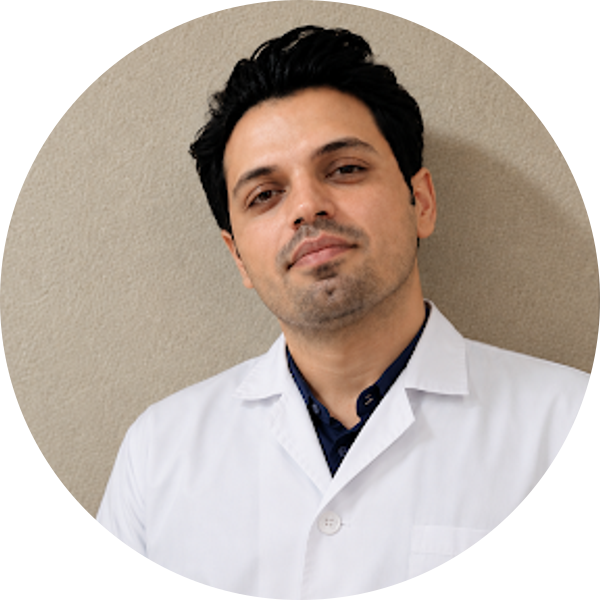
Ali Mirzakhani
PhD Candidate in Neuroscience MSc Biomedical Engineering
YOU ARE THE EXPERIMENTOne short trial · mouse or touch
Same distance. Three target sizes. How does precision change your movement?
Try a different strategy on your next run.
3 sizes · 6 timed hits per sizeReady
AB
↔Speed meets precisionTap the glowing target, then alternate sides.
Miss · keep going
Start when comfortable. The first hit anchors your position and is not timed.
Follow your selected instruction. Misses count; the timer keeps running. Size-block order is randomized. Keep the window and device orientation unchanged.
YOUR MOVEMENT, VISUALIZEDNo measurements yet
· · ·
Your 18 measured movements will appear here. Nothing is uploaded or saved.
Prediction: when the target shrinks but distance stays fixed, what might change?
What does this measure?
Each point is a successful target-to-target interval, including time spent correcting misses. The anchor click before each size block is excluded. Distance is fixed within this trial; target-size order is randomized. There are only six acquisitions per size.
Mouse, touchscreen, display size, input latency, practice, fatigue and browser timing affect the result. This is an educational demonstration of a speed–accuracy trade-off, not a clinical test or a diagnostic score. Keyboard walkthroughs are unmeasured. The last completed run is retained in memory for an optional strategy comparison; Reset or reload clears it. No result leaves this page.
The chart groups your actual intervals by target width; it does not fit a movement law from these few trials. Comparing strategies is exploratory: order, practice and fatigue are not controlled.
Try the target-acquisition task in presentation mode: fixed distance, three target widths, six timed successful transfers per width. Inspect actual intervals and misses. The initial anchor is excluded; correction time remains in the measured interval. This is a classroom demonstration, not a clinical test.
A classroom movement measure, not a validated clinical biomarker. Actual results from this page only. Informal target-acquisition task; device and practice affect timing. Fitts · 1954 ↗
Explanation
English
This task keeps the target distance fixed and uses three target widths. Each width begins with an unmeasured anchor hit, followed by six timed successful transfers. A miss does not restart the interval, so the time spent correcting it remains in the measurement.
Inspect your actual intervals and misses. Device and practice affect timing, and a short trial may not show the expected pattern. This is an informal classroom movement measure, not a validated clinical biomarker.
EXPLORE THE MEASUREMENT
What can AI measure in a walk?
01
Make a movement measurable
Reveal the body points. Move through time. Follow the ankle trajectory.
Explore the sequence to see how positions become a trajectory.
Original teaching illustration. No patient video or AI inference is running.
Reveal the body landmarks, move through the sequence and follow the ankle trajectory. Positions across time become a movement trajectory that can be inspected.
This is an original synthetic teaching illustration. No patient video or AI inference runs here. A digital movement measure still needs a defined purpose and validation.
THE COMPUTATIONAL CHAIN
From pixels to clinical information
01 / OBSERVE
Video
Images recorded under a repeatable protocol.
→
02 / ESTIMATE
Body points
Pose models estimate visible landmarks.
→
03 / MODEL
Movement
Geometry and biomechanics turn coordinates into estimates.
→
04 / INTERPRET
Clinical meaning
Evaluate the measure for the intended population and use.
Finding a knee in an image is one step in the measurement process.
Conceptual workflow; no tracking output or animal dataset is fabricated here. Mathis et al. · Nature Neuroscience 2018 ↗. Check labels, occlusion and tracking error in the actual recording.
DORKENWALD ET AL. / NATURE 2024
Can we reconstruct a brain?
139,255reconstructed neurons
54.5millionchemical synapses in the published connectome
One adult female fruit-fly brain. A structural map opens new questions about function.
Dorkenwald et al. · Neuronal wiring diagram of an adult brain · Nature 634, 124–138 (2024). The synapse count describes the published reconstructed connectome, not every synapse in the tissue.
Persian-language event · ۲۲ آذر ۱۴۰۵ · گروه علوم اعصاب و مطالعات اعتیاد، دانشکدهٔ فناوریهای نوین پزشکی. Meeting details are announced on the event page.
Study populations, intended uses and limitations matter. Each lecture illustration is distinguished from published evidence. This reading list is outside the 30-minute class.

 Join the opening experimentScan or tap · use your own phone